The City That Eats You Alive: Speed Grapher's Tokyo as a Living Monument to Corruption
The City That Eats You Alive: Speed Grapher's Tokyo as a Living Monument to Corruption
There's a moment early in Speed Grapher where the camera lingers on Tokyo's skyline — all blazing LED signage, glass towers catching the wet glow of streetlights below — and it hits you: this city is not neutral. It's watching. It's feeding. If you grew up on American crime television or spent a weekend rewatching Blade Runner for the fifth time, that feeling is going to feel real familiar, and that's no accident.
Speed Grapher's production team built a version of Tokyo that functions less like a setting and more like a predator. Every visual choice — the lighting, the camera angles, the way certain districts are framed versus others — is doing heavy narrative lifting. This is urban noir done through an anime lens, and for US fans who've trained their eyes on that specific visual language, it rewards close attention.
Glass and Grime: Two Tokyos, One Frame
One of the smartest things the show does is refuse to let you forget that there are two cities occupying the same geography. There's the Tokyo of the Roppongi Club crowd — marble interiors, warm amber lighting, the kind of soft glow that makes wealth look almost sacred. Then there's the Tokyo that exists below that — cramped, overlit in the harsh blue-white of convenience store fluorescents, all concrete and shadow.
The production design keeps these two worlds visually distinct in ways that feel almost architectural. When Saiga is moving through his world — the streets, the back alleys, the worn-down apartments — the color palette cools significantly. Blues and grays dominate. Light sources are harsh and functional rather than flattering. Compare that to the interiors of the Tennozu Club and its associated spaces, where everything is bathed in golds and deep crimsons that make decadence look almost ceremonial.
For anyone who's watched The Wire and noticed how meticulously that show used Baltimore's physical spaces to communicate class division without spelling it out, this approach is going to click immediately. Speed Grapher is doing the same thing — letting the city's visual grammar say what the characters sometimes can't or won't.
Rain as a Moral Condition
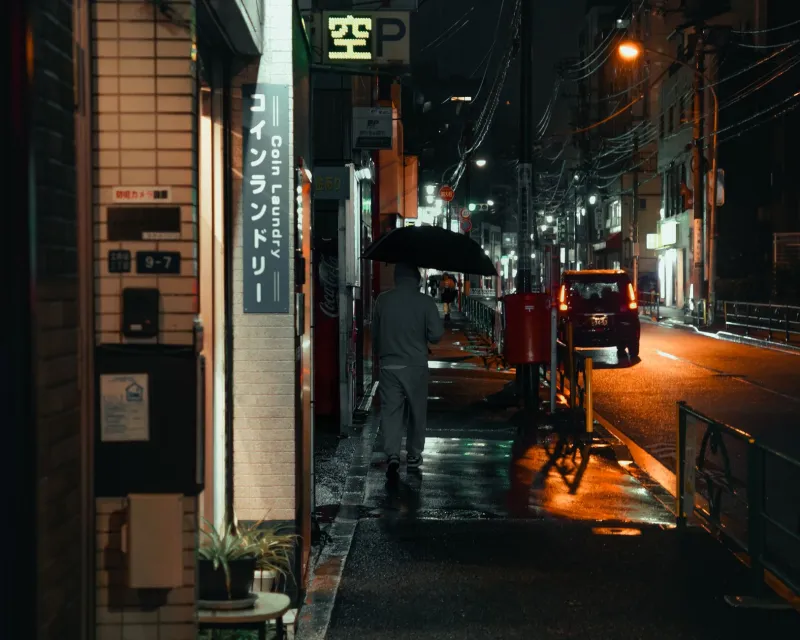
It rains a lot in Speed Grapher's Tokyo. That's not a weather report — it's a design decision. Rain in this series functions the way it does in classic American noir cinema: as a visual metaphor for moral ambiguity and the relentless pressure of a corrupt system bearing down on everyone in it.
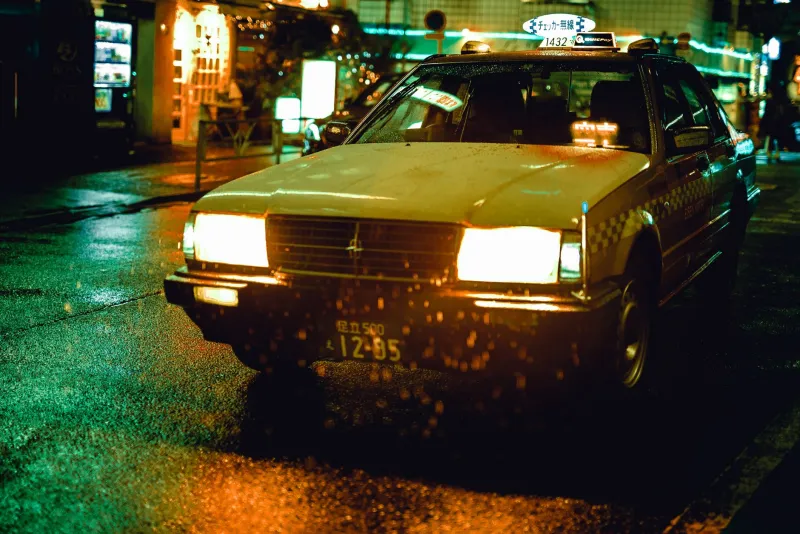
Wet streets serve a practical visual purpose too. They reflect neon signage and artificial light, effectively doubling the city's visual chaos without adding more elements to a frame. The result is this layered, almost hallucinatory quality to nighttime exterior shots — light bleeding across pavement, colors smearing together — that makes Tokyo feel simultaneously beautiful and deeply wrong. Gorgeous and rotten at the same time, which is kind of the whole thesis of the show.
Think about how Blade Runner used perpetual rain to build a world where the sky itself had become hostile, where even the atmosphere was something manufactured and oppressive. Speed Grapher pulls from that same well. The rain in this Tokyo isn't cleansing anything. It's just redistributing the filth.
Framing Power: What the Camera Chooses to Show
Pay attention to how differently the show frames locations depending on who they belong to. Spaces controlled by the Tennozas and their circle are frequently shot from low angles, making architecture loom over the viewer — a visual shorthand for institutional dominance that American audiences will recognize from political thrillers and crime dramas going back decades. These buildings don't just house powerful people; they perform power.
Saiga's spaces, by contrast, tend toward tighter framing. Narrower corridors, closer shots, more visual clutter in the background. It communicates constriction without anyone having to say the word. He is a man with limited room to maneuver, and the visual language of his environment makes you feel that physically before your brain consciously registers it.
This kind of spatial storytelling is something anime can do particularly well when the production team is committed to it, and Speed Grapher's team clearly was. Background art in anime is often treated as wallpaper — functional but not especially intentional. Here it's closer to set design in a prestige cable drama, chosen and composed to reinforce theme.
The Neon Lie
There's something specific about neon signage in noir aesthetics that Speed Grapher leans into hard. Neon is, by its nature, a kind of beautiful deception — it's gas being excited into light, color that doesn't exist in nature, manufactured radiance designed to attract attention and signal something appealing. In Tokyo's entertainment and commercial districts, it's everywhere, and the show uses that saturation to suggest a city that has perfected the art of attractive surfaces concealing ugly realities.
For American viewers, this visual language maps onto a long tradition of noir cities — the Las Vegas of casino films, the Los Angeles of Chinatown, the New York of Taxi Driver — where the brightest lights tend to mark the most dangerous places. Speed Grapher's Tokyo fits comfortably into that lineage while remaining distinctly itself. It's not imitating those cities; it's drawing from the same well of ideas about what urban modernity does to human beings when inequality goes unchecked.
Why This Still Hits
Speed Grapher came out in 2005, and the specific flavor of post-bubble Japanese economic anxiety that shaped its world has its own historical context. But the visual argument the show makes about cities — that they can be designed to serve some people while consuming others, that beauty and corruption can occupy the same physical space, that the most dangerous things often look the most attractive — that argument hasn't aged a day.
For US fans who came to this series through its reputation as a dark, underappreciated gem, the city itself might be the most underappreciated element of all. Characters get analyzed, powers get discussed, the censorship controversies get relitigated. But Tokyo — this specific, crafted, morally charged version of Tokyo — deserves its own seat at the table.
It's not just where the story happens. It's part of what the story is saying. And if you slow down and let yourself really look at the frames, you'll start to see the city the way Saiga sees it through his viewfinder: beautiful, damning, and impossible to look away from.